How Much Per Month to Reach $100K? (It's Less Than You Think)
$100,000 feels like a massive milestone — and it is. But here's the thing most people don't realize: reaching $100K is more about consistency than earning a huge salary. With the right savings rate and a decent interest rate, the math works in your favor far faster than you'd expect. Let's break down exactly what it takes, month by month.
Want to test your own numbers instantly? Use our savings goal calculator, set to $100,000 in 10 years to find your exact monthly target.
To reach $100,000 in 10 years with an assumed 7% average investment return, you need to invest approximately $580/month. In 15 years at the same rate, it drops to just $315/month. Starting earlier makes a dramatic difference — time is your biggest advantage.

Reaching $100,000 is more about consistency and time than earning a high salary.
The $100K Savings Table (Monthly Amount Needed)
Here's what you need to save each month to reach $100,000, assuming you start from $0:
- 5 years at 5%: $1,474/month
- 5 years at 7%: $1,397/month
- 10 years at 5%: $644/month
- 10 years at 7%: $580/month
- 15 years at 5%: $374/month
- 15 years at 7%: $315/month
- 20 years at 5%: $243/month
- 20 years at 7%: $192/month
- 25 years at 7%: $123/month
- 30 years at 7%: $82/month
Look at that last number: $82/month for 30 years at 7% gets you to $100,000. That's less than most people spend on streaming subscriptions and coffee combined. The magic isn't the amount — it's the time you give compound interest to work.
How Long Does It Take to Save $100,000?
Flip the question around: if you already know what you can put aside each month, here is roughly how long $100,000 takes from $0 at an assumed 7% average investment return (compounded monthly):
- $300/month: about 15.5 years
- $500/month: about 11 years
- $1,000/month: about 6.6 years
- $1,500/month: about 4.7 years
In cash with no growth, the same amounts take 27.8, 16.7, 8.3 and 5.6 years. To get your own timeline, use the savings goal calculator in "time to my goal" mode.
What If You Already Have Some Savings?
Starting with a lump sum dramatically reduces your monthly requirement. Here's what $10,000 already saved does to your timeline at 7% annual returns:
- 10 years: Need $464/month instead of $580 (saved $116/month)
- 15 years: Need $226/month instead of $315
- 20 years: Need $114/month instead of $192
Even a modest head start cuts your monthly burden significantly. Use our monthly-contribution calculator to see how your existing savings change the equation.
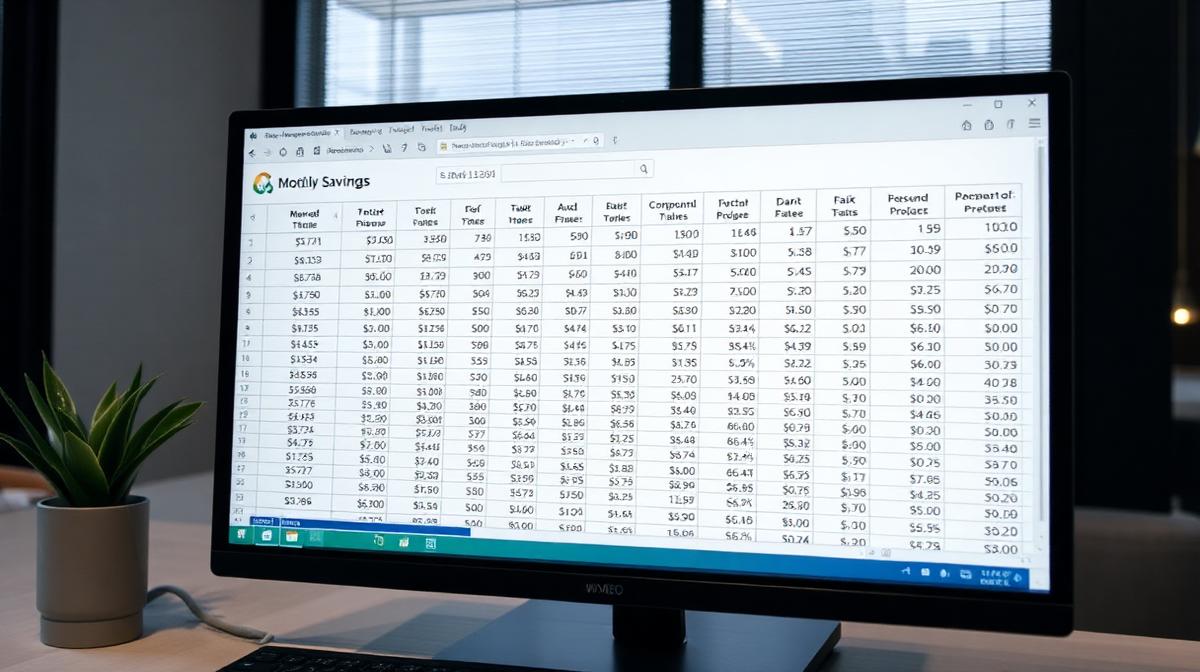
Different timelines and interest rates dramatically change your required monthly savings.
The Interest Rate Makes a Bigger Difference Than You Think
Over 20 years, saving $300/month:
- At 3% (savings account): $98,400
- At 5% (bonds/CDs): $123,300
- At 7% (index funds): $156,600
- At 10% (aggressive growth): $227,800
The same $300/month produces vastly different results depending on where you put it. A high-yield savings account is great for emergency funds, but for a long-term $100K goal, investing typically outperforms saving by a wide margin.
A Realistic Plan for Different Incomes
- Earning $30K/year: Save $150/month → reach $100K in ~22 years at 7%
- Earning $50K/year: Save $350/month → reach $100K in ~15 years at 7%
- Earning $75K/year: Save $600/month → reach $100K in ~10 years at 7%
- Earning $100K/year: Save $1,000/month → reach $100K in ~7 years at 7%
The point isn't that you need to earn a lot — it's that any income level can reach $100K with enough time and consistency.
The Hardest Part: Getting to $100K (Then It Gets Easier)
There's a well-known concept in personal finance: the first $100,000 is the hardest. Why? Because after $100K, your money starts generating meaningful returns on its own. At 7%, $100,000 earns about $7,000/year in interest alone. That's like having an extra $583/month being saved for you — automatically.
This is why the journey from $100K to $200K typically takes half the time of $0 to $100K. The complete guide to growing your money explains this compounding acceleration in depth.

The first $100K is the hardest — after that, compound interest accelerates everything.
5 Strategies to Get There Faster
- Automate your savings. Set up auto-transfers on payday. Money you never see is money you never spend.
- Increase with every raise. Got a 3% raise? Redirect at least half to savings.
- Use a high-yield account. The difference between 0.01% and 4.5% is thousands of dollars over a decade.
- Invest for long-term goals. For goals 5+ years away, index fund investing historically outperforms savings accounts.
- Cut one recurring expense. Cancel one $50/month subscription and redirect it — that's $600/year more compounding for you.
Frequently Asked Questions
The Bottom Line
Reaching $100,000 is absolutely achievable at any income level — the only variables are how much you save monthly and how long you give compound interest to work. Even $150/month can get you there. The key is starting now, automating your contributions, and letting time do the heavy lifting. Use our savings calculator to find your exact monthly number and set your target today.
Found this useful?
Share it with someone who should start investing today.
Try It Yourself
Use our compound interest calculator to see how your money could grow based on your own inputs.
Related Calculations
People reading this often check these next.
Invest $1,000/Month at 7% for 10 Years — It Could Grow to $173K
$120K deposited + $53K in compound interest = $173K+. See the year-by-year breakdown and w
$500 a Month for 10 Years: Saved vs Invested (Real Numbers)
If you invest $500 a month for 10 years at 7% you end with about $86,542 — $60,000 deposit
How Much to Save Monthly to Reach $500K? (The Real Math)
Most people overestimate what it takes to hit $500K. See the exact monthly amount at every
Savings Goal Calculator
See how long until you hit your goal