What Happens If You Invest $100 a Month for 30 Years?
One hundred dollars a month. It's less than most car payments, less than many gym memberships. Yet invested consistently for three decades, it builds wealth that surprises even experienced investors. The math behind long-term compounding is counterintuitive — the biggest gains happen in the final years, not the first. Here's exactly what $100/month produces over 30 years.
Investing $100/month for 30 years at an assumed 7% average annual return gives you approximately $121,997. Your total contributions are just $36,000, meaning investment growth adds $85,997 — more than triple what you deposited.
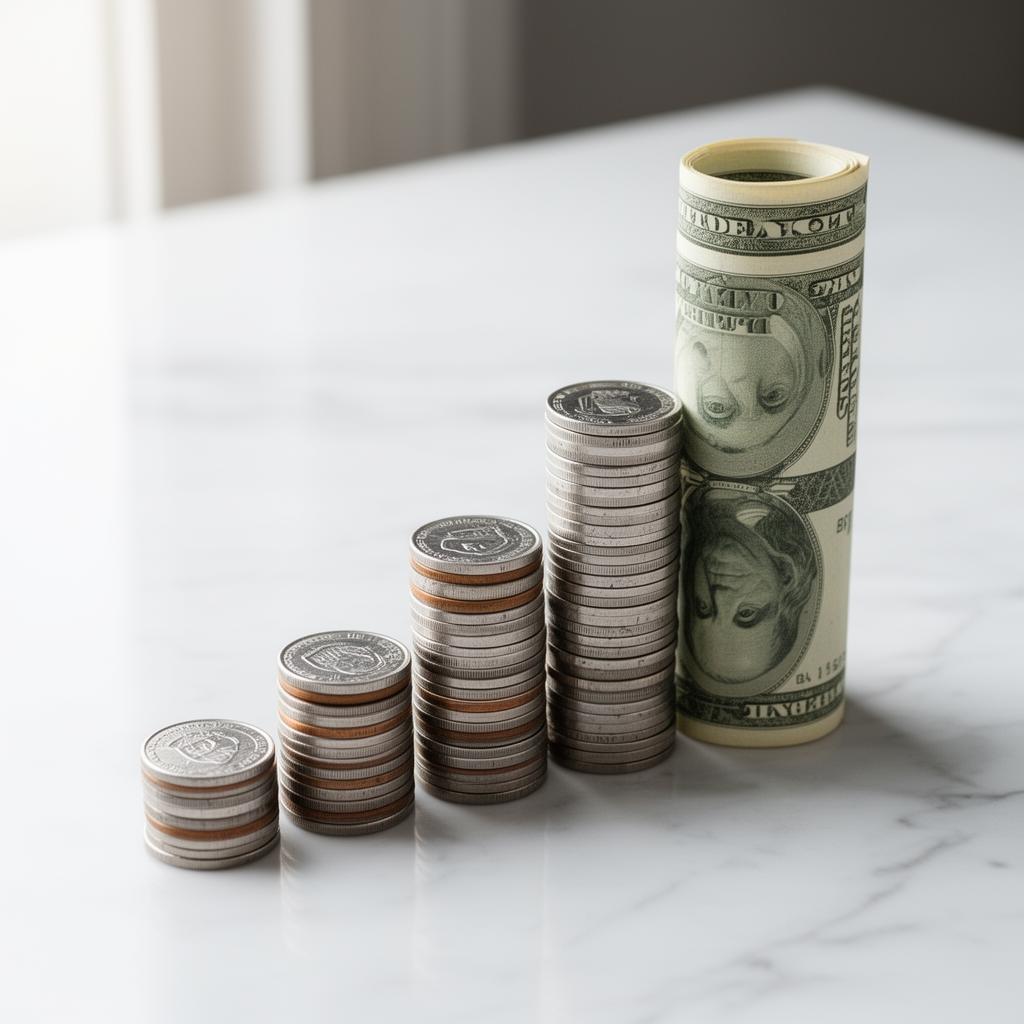
Even modest monthly investments create dramatic wealth over a 30-year compounding period.
Your 30-Year Result at Every Major Return Rate
Starting from zero, investing $100 every month for 360 months:
- At 3% (high-yield savings): $58,274 — interest adds $22,274
- At 5% (balanced bonds): $83,226 — compound growth contributes $47,226
- At 7% (index funds): $121,997 — interest exceeds deposits by 2.4x
- At 8% (growth portfolio): $149,036 — interest is $113,036
- At 10% (aggressive equities): $226,049 — your money grows 6.3x your contributions
The difference between a 3% savings account and a 10% equity portfolio is a staggering $167,775 — on the exact same $36,000 in deposits. Over three decades, your investment vehicle matters far more than the amount you invest.
👉 Model your own scenario with our free investment calculator
Year-by-Year Growth at 7%
Here's your approximate balance at key milestones with $100/month at 7% compounded monthly:
- Year 1: $1,239 (contributed $1,200)
- Year 3: $3,993 (interest is $393)
- Year 5: $7,159 (interest crosses $1,159)
- Year 10: $17,308 (interest totals $5,308)
- Year 15: $31,696 (interest now $13,696)
- Year 20: $52,093 (interest reaches $28,093)
- Year 25: $81,007 (interest is $51,007)
- Year 30: $121,997 (interest totals $85,997)
The pattern is unmistakable: your first decade generates about $5,300 in interest. Your second decade generates $22,800. Your third decade generates $58,600. The final ten years alone contribute nearly half of all interest earned — that's the exponential nature of compound growth in action.
What If You Adjust the Monthly Amount?
Life evolves over 30 years. Here's how nearby amounts compare at 7%:
- $50/month: $60,999 (you deposit $18,000)
- $100/month: $121,997 (you deposit $36,000)
- $150/month: $182,996 (you deposit $54,000)
- $200/month: $243,994 (you deposit $72,000)
- $300/month: $365,991 (you deposit $108,000)
- $500/month: $609,985 (you deposit $180,000)
Every additional $100/month adds approximately $121,997 over 30 years at 7%. If you start at $100 and increase by $25 every five years as your career advances, you'll significantly outperform the flat $100 projection.
Consistency is the most important factor — the calendar is your greatest investment ally.
The Power of Starting With a Lump Sum
Combining an initial deposit with $100/month at 7% over 30 years:
- Starting with $5,000: $162,580 — the lump sum grows to $40,582 on its own
- Starting with $10,000: $203,162 — your $10K nearly octuples
- Starting with $25,000: $324,910 — a quarter of a million just from the initial deposit
A $10,000 head start adds about $81,000 to your 30-year total because that money compounds for the entire three decades. Front-loading your account — even with a modest amount — dramatically amplifies the final result.
👉 See the impact of a lump sum in our compound interest calculator
Who Invests $100/Month — And Why It's Powerful
$100/month is deliberately accessible. For someone earning $35,000 annually, it's roughly 3.4% of gross income — well below the minimum savings thresholds recommended by most financial advisors. Yet over 30 years, it builds six figures.
Strategies for making $100/month automatic:
- Automate through your brokerage. Set up recurring investments into a total market index fund on the 1st of each month. Most platforms allow this with zero fees.
- Use your employer match. If your employer offers 401(k) matching, $100/month from your paycheck could effectively become $150-$200/month including the match — free money that compounds for decades.
- Round up daily purchases. Some investing apps round up every purchase and invest the difference. Even without deliberate saving, this can approximate $100/month.
- Redirect one subscription. Canceling a single streaming service, meal kit, or unused membership frees up $10-15/month instantly. Stack three or four and you've reached $100.
Why 30 Years Is the Magic Number
Thirty years isn't arbitrary — it's the approximate working career of someone starting at 25 and retiring at 55, or 35 to 65. Here's why this timeframe is transformative:
- At 10 years: Interest earned equals 31% of your total balance
- At 20 years: Interest earned equals 54% of your total balance
- At 30 years: Interest earned equals 70% of your total balance
By year 30, for every dollar in your account, only 29 cents came from your pocket. The other 71 cents were created by compound interest. This is the fundamental reason why starting early — even with small amounts — beats starting later with larger contributions. Learn more about how starting age dramatically affects your wealth.
What Happens If You Keep Going?
If you continue past 30 years at 7%:
- Year 35: $180,105 (deposited $42,000)
- Year 40: $262,481 (deposited $48,000)
- Year 45: $379,259 (deposited $54,000)
From year 30 to 40, your balance more than doubles from $121,997 to $262,481 — and you only add $12,000 in new contributions. The account essentially starts compounding at a rate that dwarfs your monthly deposit.
👉 Plan your extended timeline with our savings calculator
3 Mistakes That Undermine a 30-Year Investment Plan
- Pausing during market downturns. Stopping contributions when prices drop means you miss buying at discounted prices. Dollar-cost averaging works precisely because you buy more shares when prices are low. Every bear market in history has been followed by a recovery.
- Choosing high-fee funds. A 1% annual expense ratio on a 7% gross return reduces your 30-year total from $121,997 to approximately $98,000 — a $25,000 penalty. Choose index funds with expense ratios under 0.10%.
- Cashing out early. Withdrawing $20,000 in year 15 doesn't just cost $20,000 — it costs the $60,000+ that money would have grown to by year 30. Treat long-term investments as untouchable.
Frequently Asked Questions
The Bottom Line
Investing $100/month for 30 years is one of the most accessible paths to six-figure wealth. At 7%, you'll accumulate over $122,000 — with compound interest contributing nearly three-quarters of the total. The key insight: your first decade builds the foundation, but your third decade does the heavy lifting. Start today, automate the process, and let time do the work. Use our investment calculator to model your exact scenario.
Found this useful?
Share it with someone who should start investing today.
Try It Yourself
Use our compound interest calculator to see how your money could grow based on your own inputs.
Related Calculations
People reading this often check these next.
Invest $250 a Month for 20 Years: What It Could Grow To
$250/month for 20 years at 7% = $130,000+. That's $60K deposited and $70K+ in free money f
Invest $500/Month for 20 Years: How to Build $260K+ From Scratch
$500/month × 20 years = $120K deposited. At 7% returns? $260K+. Compound interest adds $14
Start Investing at 20 vs 30 vs 40 — The Cost of Waiting Is Brutal
Starting 10 years late can cost you $400,000+. See the exact dollar difference between inv
Investment Growth Calculator
Advanced scenarios with inflation & tax