Save $100/Month for 5 Years — Here's What You'll Actually Have
One hundred dollars a month doesn't sound like much. It's a couple of takeout orders, a gym membership, or half a streaming bundle. But what happens when you redirect that amount into savings or investments consistently for five years? The answer might surprise you — especially when compound interest enters the picture.
Investing $100/month for 5 years at an assumed 7% average annual return produces approximately $7,159. You'll have deposited $6,000, and compound interest contributes an additional $1,159. At a 5% rate, the total is about $6,801.
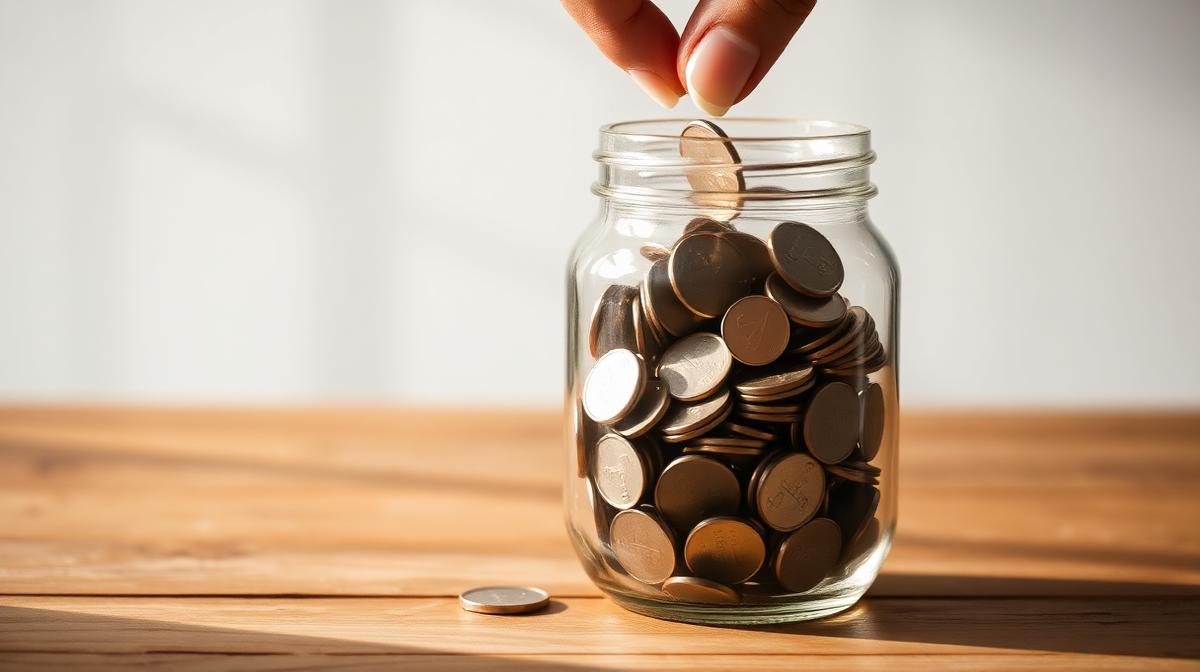
Consistent small deposits create surprisingly large balances over five years.
Your 5-Year Outcome at Every Major Rate
Starting from $0 with $100 deposited every month for 60 months:
- At 2% (standard savings): $6,305 — interest adds $305
- At 3% (high-yield savings): $6,465 — low risk, modest growth
- At 5% (CDs / bond funds): $6,801 — a solid return for conservative investors
- At 7% (index funds): $7,159 — compound growth adds nearly 20% extra
- At 10% (aggressive equities): $7,744 — maximum growth with higher volatility
Even at a conservative 3%, you earn over $465 from interest alone — money you didn't have to work for. At 7%, that bonus grows to $1,159. The point isn't whether $100 is a large amount; it's that consistency transforms small deposits into meaningful wealth.
👉 Try your own scenario — adjust amount, rate, and timeline instantly
Month-by-Month: How Your Balance Builds
At 7% compounded monthly, here's your approximate balance at key milestones:
- Month 6: $612 (contributed $600, earned $12)
- Month 12: $1,240 (contributed $1,200, earned $40)
- Month 24: $2,570 (contributed $2,400, earned $170)
- Month 36: $4,003 (contributed $3,600, earned $403)
- Month 48: $5,548 (contributed $4,800, earned $748)
- Month 60: $7,159 (contributed $6,000, earned $1,159)
In the first year, interest barely registers. By year five, interest is generating more each month than it did in the entire first year. This acceleration is modest at $100/month over five years, but it establishes the habit and infrastructure for much larger results over longer horizons.
Why $100/Month Matters More Than You Think
The financial significance of $100/month extends well beyond the five-year window. Consider the long-term trajectory at 7%:
- 5 years: $7,159
- 10 years: $17,308
- 20 years: $52,093
- 30 years: $121,997
- 40 years: $262,481
That's right — $100/month for 40 years at 7% creates over a quarter million dollars. Your total deposits over that period would be $48,000, meaning compound interest contributes $214,000 — more than four times what you put in. The five-year plan is just the beginning of a much larger story.

Starting with $100/month builds the discipline that leads to far larger savings over time.
👉 See your 10, 20, or 30-year projection — try our compound interest calculator
What If You Increase to $200 or $300?
Many people start at $100 and scale up as their income grows. Here's the five-year impact of graduating to higher amounts at 7%:
- $100/month for all 5 years: $7,159
- $100 for 2 years, then $200 for 3 years: ~$10,800
- $200/month for all 5 years: $14,318
- $300/month for all 5 years: $21,477
- $500/month for all 5 years: $35,796
Doubling your contribution doubles your result — but the interest earned more than doubles because the larger balance compounds faster. If you receive a raise, redirecting even half of the net increase into savings can accelerate your growth curve significantly. Learn more about strategies to grow savings faster.
Where to Put $100/Month for 5 Years
Your account choice should match your goal and timeline:
- Emergency fund → High-yield savings account (4-5% APY). Fully liquid, FDIC-insured, and earning competitive interest. Best for money you might need unexpectedly within the five-year window.
- Medium-term goal → CDs or bond ETFs (4-6%). Slightly better returns with modest restrictions on access. Suitable for planned purchases like a car down payment or vacation fund.
- Long-term wealth building → Index fund (7-10%). If your timeline is flexible and you can tolerate short-term drops, index funds historically deliver the best returns over five or more years. Consider a Roth IRA for tax-free growth even with small amounts.
The Psychology of Small Savings
Beyond the math, starting with $100/month builds two things that no calculator can measure:
- The habit of paying yourself first. Automating $100/month on payday rewires your spending patterns. After three months, you stop noticing the transfer. After a year, the growing balance becomes its own motivation.
- Financial confidence. Watching your balance cross $1,000, then $3,000, then $5,000 creates a positive feedback loop. Many people who start at $100/month naturally increase their rate within the first year because the progress feels tangible and achievable.
The worst financial plan isn't a conservative one — it's no plan at all. Starting at $100/month puts you ahead of the 44% of Americans who can't cover a $1,000 emergency expense.
What If You Add a Starting Balance?
Combining a small lump sum with monthly deposits amplifies results. At 7% over 5 years with $100/month:
- Starting with $0: $7,159
- Starting with $1,000: $8,577 (the $1,000 adds $1,418 including its own growth)
- Starting with $2,500: $10,713
- Starting with $5,000: $14,267
A $5,000 head start nearly doubles your five-year outcome because that lump sum compounds for the entire period. If you have any existing savings — even a forgotten account — consider combining it with your monthly plan.
👉 See what happens if you invest more — try our investment growth calculator
Frequently Asked Questions
The Bottom Line
Saving $100/month for five years won't make you wealthy overnight, but it will give you $7,159 at 7% — and more importantly, it builds the foundation for exponential growth in the decades ahead. The hardest part is starting. Once the habit is automated and the balance starts climbing, momentum takes over. Plug your numbers into our savings calculator and see exactly where you'll be in five years.
Found this useful?
Share it with someone who should start investing today.
Try It Yourself
Use our compound interest calculator to see how your money could grow based on your own inputs.
Related Calculations
People reading this often check these next.
Save $200/Month for 10 Years — This Is How Ordinary People Build Wealth
$200/month is all it takes. After 10 years with compound interest, you'll have $34K+ — tha
How Much Is $300 a Month for 10 Years? Savings vs Investing
$300/month for 10 years = $36K deposited. Compound interest adds up to $25K on top. See th
$100 vs $1,000 a Month Invested: The Difference After 20 Years
Think $100/month doesn't matter? We compared it head-to-head with $1,000/month over 20 yea
Savings Goal Calculator
See how long until you hit your goal